
Getting Students Ready for Rigor Happens Best In Community

Don’t just build a classroom community. Build a community of learners.

Instructional rigor doesn’t happen in isolation. It thrives in a culture where students feel safe, supported, and challenged to stretch themselves. The Ready for Rigor approach rests on the idea that learning is a social act, and that a true community of learners is built intentionally.

Here are the three pillars that create this kind of environment:

Establish a Culture of Learning

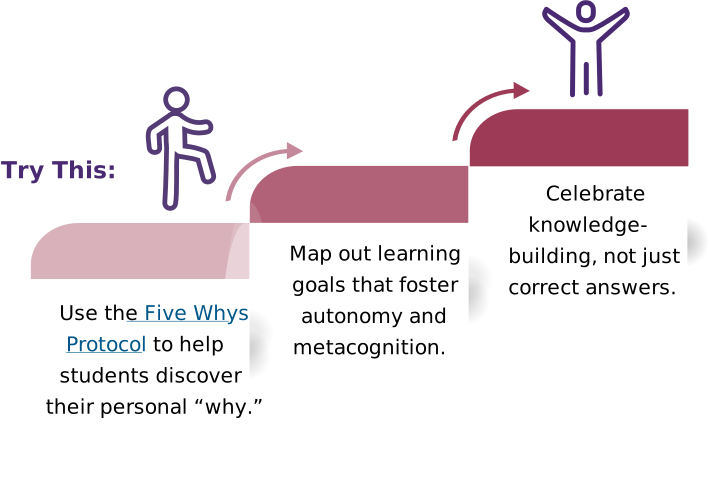
Help students find a more satisfying way to do school.

Students often internalize the “game of school”—just comply, complete tasks, and get good grades. The Ready for Rigor® framework helps disrupt that cycle by shifting the focus from performance to learning how to learn.

In a true learning culture:

  • Students know the language, tools, and procedures of learning.
  • Knowledge building is prioritized over test performance.
  • Feedback, reflection, and self-regulation are routine parts of learning.
  • Growth is seen as a shared goal, not a solo journey.

Shift Academic Mindsets

Support the development of learner identity.

Mindset isn’t just about motivation, it’s about how students see themselves as learners. A strong learner identity equips students to take on more complexity, bounce back from setbacks, and persist through productive struggle.

Introduce and reinforce these four core mindsets:

I can succeed at this.

The degree to which students believe they are “good” at a particular kind of task or field of study is strongly associated with academic perseverance.

My ability and competence grow with my effort.

The degree to which students have a growth-mindset means they are more likely to interpret academic challenges or mistakes as opportunities to learn and develop their brains.

I belong to this academic community.

A strong sense of academic belonging where students see themselves as members of not only a social community, but an intellectual community.

This work has value for me.

The intrinsic value placed on academic tasks and topics that connect in some way to students’ lives, future educational pursuits, or current interests.

Create a Culture of Errors

Reframe mistakes as information.

The brain learns best from feedback loops—especially from errors. But only when those errors are seen as informative, not as failure.

Use the “First Pancake” Metaphor: The first try might flop, but it helps refine the recipe. Learning works the same way.

To build a culture of errors:

Normalize making mistakes as part of growth.
Give actionable, timely feedback that supports reflection.
Teach the difference between mistakes and errors:
  • Mistakes = inattention or carelessness.
  •  Errors = misconceptions or underdeveloped skills.
Help students build a vocabulary to discuss and learn from errors.

Tools to Help You Teach for Equity and Rigor

NAME OF RESOURCE

NAME OF RESOURCE ​

NAME OF RESOURCE ​

Join Our Community

Sign up for the Ready for Rigor newsletter to get:

  • Actionable tips to evolve your practice and empower all students to think, grow, and succeed
  • Exclusive resources and tools to guide your learning journey
  • Personal reflections and insights straight from Zaretta Hammond
  • Early access to information about upcoming courses, events, and more