With the growth of research findings from the science of reading, school districts are rapidly retooling their literacy programs for the early grades. But what about our older students in middle school and early high school?
To make good on our promise to get every student college and career-ready, we have to address the current literacy challenge for older students in grades 5–9. Despite the heavy investment in literacy, we still have districts where 30% or fewer of students are reading at grade level or above in middle school. That means they will enter 9th grade without the requisite reading skills to access grade-level material and to take on the rigors of high school.
Older students typically come into the upper grades with the following issues:
Weak decoding skills that result in slow reading comprehension
Lack of advanced decoding skills to tackle big, multisyllabic words found in academic texts
Shallow word knowledge, which leads to shallow background knowledge and anemic writing
Learning to read English while trying to learn new content.
While upper elementary and secondary teachers feel confident in their subject knowledge and pedagogy, they often say they struggle with getting their most vulnerable students reading at grade level when they come to them more than six months behind because they weren’t trained to teach foundational reading skills.
This can lead well-intentioned teachers to find ways around students’ poor skills rather than actually filling their reading gaps. We are using the excuse of creating “equitable access” for our over-scaffolding, rather than helping students strengthen their skills and close their reading gaps incrementally. We address this in this upcoming masterclass series.
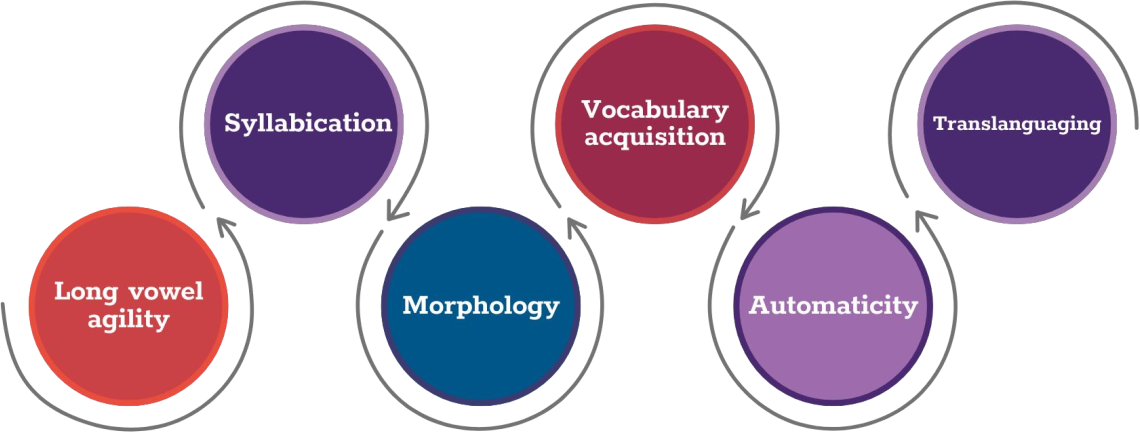
With the growing body of evidence-based practices from cognitive neuroscience, the science of reading, and research on translanguaging, we have a unique opportunity to help older students develop six foundational skills so they can independently access high-quality, grade-level materials.
In this masterclass, using a structured word inquiry framework, we will cover the following core knowledge you need to quickly close their learning gaps in these foundational skills without dumbing down your curriculum or slowing down the instructional pace in your classroom:
How? By integrating the science of learning with the science of reading. Join me for this masterclass series to learn to integrate the two. In addition, learn how to review your existing program for the key skills students need to become proficient and how to provide opportunities for deliberate practice so students become skilled at applying their literacy knowledge to become a code breaker, meaning-maker, text user, and ultimately, a text critic.
In the six sessions of this masterclass series, we will explore how to use the science of learning to enhance the science of reading in your teaching practice. We will also explore three foundational reading skills and show you how to coach students to use them effectively. We will look at how to integrate reading skill development in core subject areas to reinforce literacy development without you having to learn to be a reading teacher. In addition, we will cover how to attend to the emotions struggling readers typically bring to help improve their reading skills.
Strengthening Structured Literacy in Tier 1 Instruction
Takeaways
Deepen your conceptual understanding of the science of reading and the select fundamentals needed to close learning gaps.
Diagnostic tools and materials for quickly assessing where students are in top three reading skills and instructional for how to use them effectively.
Sources for gamifying practices to help students build automaticity in each area.
Methods for differentiating activities to engage all students but target your struggling readers for acceleration.
Cheat sheet for integrating these strategies with your school’s reading program, including computer- based programs like Read 180, Achieve3000, and Renaissance.
Tips to help instructional coaches support those skills that come before comprehension.
Resources for continued learning beyond the masterclass series.
Integrating Structured Literacy into the Classroom to Close the Decoding Gap for Older Students Quickly
Reading instruction for secondary teachers usually focuses on comprehension. But all reading challenges show up as comprehension problems. In our opening session, we will review the reasons students arrive in secondary classrooms reading below grade level if they don’t have a learning disability.
In this opening session, participants will learn:
The most important skill gaps to help students close
Understand what fluency is and its role in comprehension
What structured literacy framework is and how the brain learns to read
Why automaticity is essential to make learning sticky for students
How the science of learning informs the science of reading.
Session 2
Long Vowel Agility to Close Decoding Gaps
Most reading challenges for secondary students, especially multilingual learners and non-standard English speakers, have their roots in the most foundational skill – long vowel agility.
In this session, we will learn ways to incorporate very targeted instruction on long vowels into any existing curriculum. We will look at the science of learning practices that help students learn this important information quickly, namely retrieval practice, timed quizzing, interleaving.
In this session, participants will learn:
The most important skill gaps to help students close
How to teach the 18 English phonemes to Spanish-speaking multilinguals
How to leverage the science of learning to make learning sticky and help students internalize key phonics content.
Session 3
Advanced Decoding Skills with Selective Syllabication to Tackle Multi-Syllabic Words
Knowing basic phonics isn’t enough for older students as they attempt to read more complex text in upper grades. They need what we call advanced decoding skills. More than old school “word attack” skills, advanced decoding requires that they learn the basics of syllabication. While there are six syllable types, only two are foundational for struggling readers in upper grades.
We will cover the two of the six syllable types students should know and how to teach them to students as well as how to coach students to apply this knowledge when reading using the science of learning.
In this session, participants will learn:
The two rules of syllabication that are essential for reading big words.
The importance of non-meaning syllables and word families.
The basic learner moves we need to coach our students through.
The five moves from the science of learning that make learning sticky.
Session 4
Morphology and Vocabulary Acquisition for Word Wealth
Another key skill older students need in order to bridge decoding and comprehension is word learning skills. The traditional practice of front loading vocabulary and having students look up definitions is ineffective. Instead, we have to engage in robust and continuous word study so that they are always curious about new words and have a cognitive routine to integrate it into their working lexicon, aka their private dictionary. This is essential as students read across a variety of subject areas beginning in middle school.
In this session, participants will learn:
How to center disciplinary literacy with word study in your subject area
The three parts of effective word study
How to actively teach vocabulary so students become “word nerds”
How to put together a strong word study
Session 5
Integration Week: Braiding it All Together During Tier 1 Instruction
This is our integration session. We’ll utilize the time for co-working on activity design, coaching dilemmas, creating a schedule for integrating literacy practice into your class schedule, and other aspects of translating our learning from previous sessions into concrete practice.
In this session, participants will learn:
How to conduct a quick assessment and use informal reading inventories to track progress
Creating a schedule that provides consistent and intense practice time for internalization
Co-working time with your team
Session 6
Strengthening Structured Literacy in Tier 1 Instruction
In our final session, we will focus on helping you set up a process for continuing to build your knowledge and skill to support secondary readers. We will process what we’ve learned and create action plans and thought partnerships from others in masterclass.
In this final session, participants will learn:
Additional resources
The opportunity to continue their learning through other online courses designed by CORE Learning